
The drawing on the Masters’s shelves (trompe l’oeils)
The drawing on the Masters’s shelves that I have painted as a trompe l’oeil is the sketch, the compass in the score of each motif. And it is the approach and the plot development of each of these trompe l’oeil paintings. In them there is always an undercurrent of my admiration and learning towards the masters referred to.
In the drawing of the Masters’s shelves of the Masters of L’Atelier de Santi (trompe l’oeils) I have carefully stored what I was looking for. The learning and the admiration I have for the masters of painting, and that is the reason for keeping my learning and my devotion on the shelves. I learn from them by observing their works with delight, recreating myself in their solutions to the challenges faced by each work.
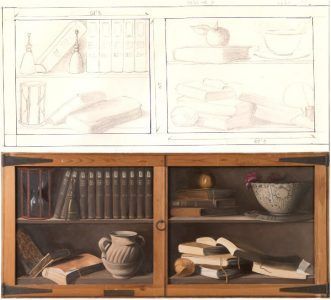
The drawing on the Masters’s shelves, “The Zurbarán’s bookcase”
First the classics
I remember that Ingres was one of the first artists I admired as a draughtsman, for his mastery and virtuosity. Before Ingres I had been attracted, without being aware of it, to many other authors. From antiquity to comics and comic strips, and also from animated films and so many other disciplines that hide the mastery of the art of drawing and design. For me, drawing is, among the non-verbal disciplines, the one that comes closest to literature. Drawing was the bridge that led me to painting. Then it was the discovery of so many masters. In some cases for their naturalism and spontaneity. In others for their classicist perfectionism.

The drawing on the Masters Velázquez Cupboard (trompe l’oeil)
And it is the drawing that is the compositional and constructive basis, in figurative painting of course, that makes possible the space where painting and colour combine and express themselves.
I have sought to unravel the drawing in the painting, first the composition of the work and then the design of each of its elements, scenes, landscapes, characters, accessory objects, etc. In the execution of the paintings of Ingres and many neoclassical painters, the phases of drawing and colour are clearly determined and delimited.

Evolution of drawing in the reinterpretation of a detail in a work by David, “Brutus and the lictors”.
And I reached Velázquez
The discipline of the “disegno” or drawing prior to the final work is not so clear in the work of Velázquez and other later Baroque painters. In their beginnings, chiaroscuro revealed to them the fact of blending tones and contours in order to seek a spatial effect beyond classical perspective. In Velázquez’s case, his knowledge of Titian’s painting was decisive. The latter, added to his naturalistic training, resulted in the so-called “Velázquezian air”. That feeling that we can surround the 2D motif of the painting, be it a person, animal or thing.
And Velázquez meant another step towards spatial synthesis, through colour with the Impressionists. And towards cubism with Cézanne, Braque, Picasso and others. Giant steps towards the current conception of art.
In my case, naturalism always brings me back to realism, and in a closed circle to naturalism again. Naturalistic observation is the lens I chose to interpret reality, the same as the masters I admire. Without detracting from the other options, also admirable, it is as if the palette and style chosen, in the case of realism, were genetic, the authenticity and truth of the author.

The drawing on the Masters “La Estantería de Velázquez”.
Inspiration from the Masters’ models
The preliminary drawing to compose my shelves is the result of a preliminary study in each case. For example, Velázquez’s La alacena (Velázquez’s cupboard) is very much inspired by the master’s youth. At that time, his production of kitchen motifs and still lifes was the majority. And, studying these works, I made a combination and a list of motifs with which I composed The Cupboard. And I did the same in the case of Velázquez’s La Estantería, but on this occasion the origin of the motifs was more diverse. I chose motifs and objects from his youth and maturity that made significant reference to his personal and brilliant work, adding elements from outside his oeuvre, such as the self-portrait by Titian, but intrinsically related to the Sevillian genius.
Drawing on the shelves, “The Velázquez shelf”